

Could Novamed Pads Reduce Your Continence Product Expenditure Without Reducing Absorbency or Patient Comfort?
Continence products are an essential part of preserving dignity, independence and quality of life for people living with bladder or bowel incontinence.
For NHS organisation, care homes and community healthcare providers, however, continence care also represents a significant and recurring expenditure. When budgets are under pressure, it can be tempting to focus primarily on the price of each pad, pant or underpad.
But the lowest-priced product is not necessarily the most economical.
A continence product that does not provide the correct absorbency, fit or comfort may need to be changed more frequently. It can also contribute to leakage, additional laundry, bedding changes, clothing replacement, waste and greater pressure on care staff.
The most useful question is therefore:
Could your organisation reduce its overall continence product expenditure without compromising absorbency, patient comfort or dignity?
Novamed believe that, with appropriate clinical assessment and product evaluation, the answer could be yes.
Continence cost savings should not come at the patient's expense.
Cost reduction should never mean automatically moving every patient to a cheaper or lower-absorbency product.
Every person has different needs. These may depend on:
- The severity and type of incontinence.
- Daytime or overnight use
- Waist and hip measurements
- Mobility and dexterity
- Skin condition
- Cognitive impairment
- The level of support available
- Whether the individual lives independently or receives professional care
NICE states that containment products should not normally be offered as a treatment for urinary incontinence but may be appropriate as a coping strategy while treatment is explored, as an addition to ongoing therapy or for long-term management when treatment has not been successful.
This means the selection of an absorbent continence product should form part of an individual care plan - not simply a purchasing decision based on unit price.
Look beyond the price per pad
An effective continence product review should consider the total cost of care.
For example, an inexpensive product may become a costly choice if it results in:
- More frequent product changes
- Regular leakage
- Increased disposal costs
- More bedding and clothing changes
- Disrupted sleep
- Additional staff time
- Complaints from users, families and carers
- Unnecessary use of higher-absorbency products
By contrast, a correctly selected product may provide better value even where its individual unit price is not the lowest.
NHS Supply Chain is increasing promoting value-based procurement, which considers patient outcomes, staff efficiency, waste and overall system value rather than focusing only on the initial purchase price.
A recent NHS Supply Chain continence-care pilot reported improvements in resident comfort, dignity and independence alongside reductions in waste and better use of staff resources. This illustrates why the entire continence-care pathway should be considered when evaluating costs.
Five ways Novamed could help reduce continence product expenditure
-
Match absorbency to the patient's actual needs
Using more absorbency than a patient needs can create unnecessary expenditure. Using too little can result in leakage, extra changes and dissatisfaction.
Novamed offers a focused range covering different levels of adult incontinence:
- Novamed Pull-up Pants: approximately 1,700 ml to 2,100ml absorbency
-
Novamed All-in-Ones: approximately 2,450 ml to 3,100 ml absorbency
- Novamed Underpads: 60 x 90 cm with four adhesive corner tabs approximately 1,700 to 1,900ml absorbency
-
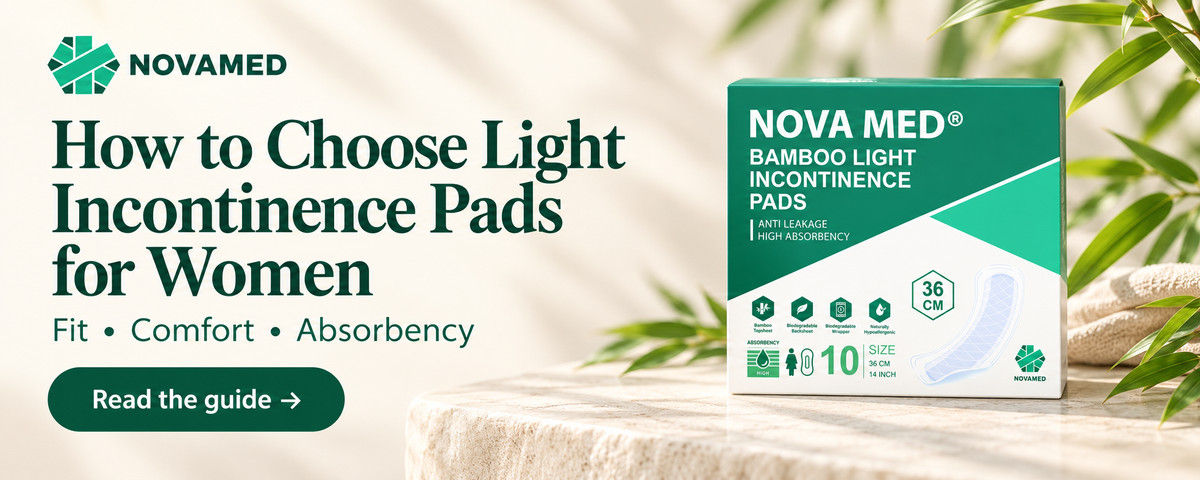
Novamed Bamboo Light Incontinence Pads: approximately 550ml absorbency
This allows providers to select products according to the individuals's level of need rather than relying on one product for every patient.
Product absorbency figures should always be considered alongside real-world fit, mobility, toileting routines and clinical assessment.
2. Reduce unnecessary product changes
Product changes should follow with the individual care plan, skin condition, comfort and manufacturer's instructions. Wetness indicators can support assessment but should not be used to delay a necessary change.
At the same time, leaving an unsuitable or saturated product in place for too long can compromise comfort, dignity and skin health.
Staff training, correct product allocation and the appropriate use of wetness indicators can help carers determine when a change is needed.
The objective should not be to restrict product use. It should be to ensure that each patient receives the right product and that it is used correctly.
3. Improve fit to help prevent leakage
Absorbency alone does not determine performance.
A highly absorbent product can still leak when:
- The size is incorrect.
- The leg cuffs are not positioned correctly.
- The product is fitted too loosely or too tightly
- A shaped pad is used without suitable fixation pants.
- The product does not match the person's body shape or mobility.
- Barrier creams or other substances interfere with absorption.
NHS continence guidance emphasises the importance of correct sizing and fitting. A larger product does not automatically provide greater absorbency, and an incorrectly fitted product may increase leakage or create discomfort.
Novamed products are available in multiple sizes, allowing patients and care teams to evaluate both capacity and fit before making a larger commitment.
4. Rationalise the number of products being purchased
Some organisations accumulate a wide range of similar continence products over time. This can make ordering, stock control, storage and staff training more complicated.
A structured product review can identify:
- Products with overlapping functions
- Items purchased in very low volumes
- Unused stock or sizes that no longer match residents' need
- Opportunities to simplify ordering while retaining essential product choice.
For care homes and NHS organisations, a carefully selected range could make stock management easier and reduce avoidable waste. However, any changes should preserve access to alternative products for people with specific clinical needs.
5. Trial products and measure the results
The most reliable way to assess whether Novamed could reduce your continence expenditure is to carry out a structured comparison with your current products.
Start with a small group of suitable, consenting users, supported by the clinical team. Record the same measures before and during the trial:
- Delivered product cost and daily consumption.
- Leakage incidents and unplanned changes.
- Laundry and bedding changes.
- Staff time spent supporting continence care.
- Patient comfort, skin condition, and user feedback.
Agree clear suitability criteria before starting. Continue with a product only where it meets the individual's needs.
This approach reflects NHS Supply Chain's emphasis on evaluating the wider benefits of continence care. Its community-care pilot reported improvements in resident experience, staff routines and waste reduction. These findings support the value of individual assessment and evaluation; they do not establish savings or clinical outcomes for Novamed products. https://www.supplychain.nhs.uk/news-article/delivering-better-continence-care/
What would a small saving mean for your care home?
Consider an illustrative example: 50 residents, each using four products daily.
If a suitable alternative costs 5p less per product, with usage unchanged:
50 residents x 4 products x £0.05 x 365 days = £3,650 annual product savings.
Actual savings depend on the quotation, product mix and assessed usage. Additional costs, including delivery, laundry and disposal, should be included in the comparison. Staff time released should be recorded separately from cash savings.
Could Novamed be the right choice for your organisation?
Novamed invites care home managers, NHS procurement teams and community healthcare providers to explore whether its adult incontinence range could meet their care requirements at a competitive overall cost.
A practical starting point is to share your current product specifications, sizes and approximate monthly usage, then request a quotation and discuss samples for evaluation.
The aim is clear: better value in continence care, with absorbency, comfort and dignity at the centre of every decision.
Contact Novamed to discuss your organisation's requirements.
Live Comfortably. Live Confidently.
References:
- Containment products and treatment: NICE NG123 — recommendations, “Absorbent containment products, urinals and toileting aids”.
- Value-based procurement and the pilot: NHS Supply Chain — Delivering Better Continence Care, 29 September 2025.
- Sizing, fitting, wetness indicators and creams: Mersey Care NHS Foundation Trust — Care and fitting advice for continence products.
- Pull-up pants absorbency and features: Novamed — Pull-up pants specifications.